

The Atlantic Ocean carries more than water. Its great circulation, a planet-scale conveyor of warm surface water flowing north and cold deep water returning south, redistributes heat on a scale that shapes weather far inland. Scientists have worried for years that this system, known by its acronym AMOC, may be weakening as the planet warms. Watching it requires one of oceanography’s most demanding instruments: a permanent web of sensors stretched across an ocean, measuring a current that never sits still.
The stakes explain the effort. A substantial slowdown would be expected to shift rainfall belts, cool parts of north-west Europe relative to the warming trend, raise sea levels along parts of the American east coast and alter marine ecosystems. A full collapse is considered unlikely this century by most assessments, but the costs of being wrong are high enough that oceanographers treat continuous measurement as essential insurance, a theme that runs through the science coverage on our homepage.
Measuring a River Inside an Ocean
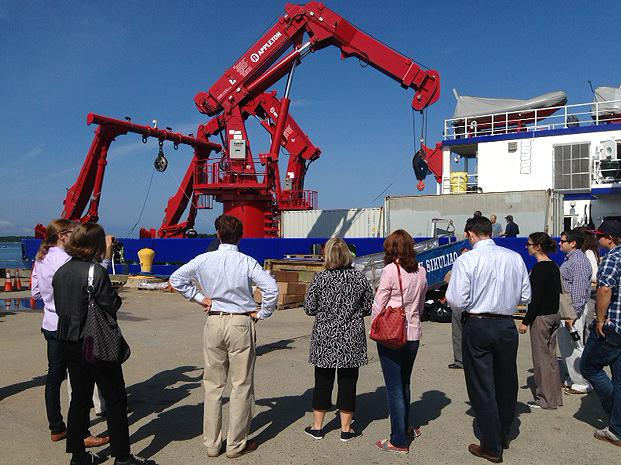
You cannot put a flow meter on a current thousands of kilometres wide. Instead, arrays of moored instruments span key Atlantic latitudes, recording temperature, salinity and pressure, from which scientists infer the strength and structure of the flow. Satellite altimeters add the sea surface’s height and slope, autonomous floats drift through the interior, and ships service the moorings through Atlantic weather that tests both steel and patience.
The records are still young by ocean standards. Direct continuous measurement of the full circulation began only in the mid-2000s, and the system varies naturally from year to year, which makes separating a trend from noise a statistical endurance test. Reanalyses combining the arrays with models, reported in journals including Nature, suggest weakening over longer periods, while individual years can buck the trend. Scientists are unusually candid about the uncertainty: the direction of concern is clear, the rate is not.
What the Sensors Are Telling Us
Alongside the moorings, indirect fingerprints accumulate. A patch of the North Atlantic south of Greenland has cooled while the world warmed, consistent with less heat arriving by current, and sea-level patterns along the United States coast carry a matching signature. Proxy records from ocean sediments extend the story back centuries, suggesting the circulation may now be weaker than at any time in that span, though proxies blur what instruments resolve.
Climate models, for their part, broadly project further weakening this century under continued warming, driven by surface warming and fresh water from melting ice making northern waters less dense and less prone to sink, the sinking being the engine of the whole system. Coverage by BBC News of successive assessment reports shows the estimates converging on weakening while keeping a wide range, the scientific equivalent of a slow alarm rather than a siren.
Why Watching Matters Even Without Certainty
Sensor networks earn their keep in two ways. First, they provide early warning: if the circulation’s decline accelerates, the arrays will see it years before the weather announces it, giving farmers, water managers and coastal planners time to adapt. Second, they discipline the models. Every improvement in the observed record narrows the range of plausible futures, and adaptation money spent against a narrower range goes further.
The Atlantic slowdown is therefore a story about instruments as much as currents. Civilisation has built thermometers for the planet’s most consequential ocean engine and is now reading them with care. The readings so far say: watch closely, prepare seriously, and do not mistake natural restlessness for either safety or disaster. In climate science, that measured middle is often where the truth is assembling itself. Continued funding for the arrays, through calm years and alarming ones alike, is what will let that truth finish assembling, and few climate investments offer clearer value for money.
